Monday, August 13, 2012

Sagas literarias. Los Reyes Malditos de Maurice Druoin.

Los Reyes Malditos de Maurice Druoin.

Los Reyes Malditos es una serie de novelas históricas escritas por Maurice Druon y publicada entre 1955 y 1977 por Del Duca:. La saga trata de cómo Felipe IV de Francia el Hermoso fue maldecido por el gran maestre de los Caballeros Templarios, Jacobo de Molay, o Jacques de Molay, ya que este monarca francés suprimió la orden debido a que debía una gran suma de dinero a los Caballeros del Temple, por el rescate que su abuelo Luis IX había pedido a éstos para liberarse de los egipcios en la VII Cruzada. Esta serie de siete libros cuenta cómo la Dinastía Capeto se extinguió...

¡Malditos, todos malditos hasta vuestra decimo tercera generación! Maldiciendo al rey de Francia Felipe IV (Felipe I de Navarra), así como a toda su descendencia, Jacques de Molay, Gran Maestre de la Orden de los Templarios fue quemado en 1314. Durante más de medio siglo, los reyes se fueron sucediendo en el trono de Francia, rodeados de altos personajes de todo jaez como Roberto de Artois. De intrigas de palacio y muertes súbitas, de revoluciones dinásticas y luchas mortales... un gran fresco épico que vivió Francia durante algunos años negros en el transcurso de los cuales Francia se transformó profundamente saliendo de la Edad Media.

Los seis primeros volúmenes han sido objeto de una nueva edición corregida, entre 1965 y 1966.

El séptimo tomo está escrito en primera persona a diferencia de los seis anteriores. El que habla en dicho libro es el Cardenal Périgord quien se la pasa recordando hechos alrededor de los reyes Juan II el Bueno de Francia y Carlos II el Malo de Navarra. No existe practicamente ninguno de los personajes de las novelas anteriores (aun con vida) y para muchos es un libro independiente de la saga.

El académico Maurice Druon consiguió un gran éxito con esta novela cuya adaptación televisiva recuerdan muchas generaciones de teleespectadores. El serial titulado "Los reyes malditos" fue televisado en 1972, antes de la aparición del séptimo volumen, con una adaptación de los seis volúmenes precedentes de Marcel Jullian, realizada por Claude Barma. Una nueva versión, realizada por Josée Dayan y escenificada por Anne-Marie Catois, fue difundida en Francia en 2005 a través de la cadena France 2, y en Canadá, en 2006, por Radio-Canada.

Dicha versión pese a ser estelarizada por Jeanne Moreau, Tchéky Karyo y Gérard Depardieu no alcanzó la buena crítica que gozaba la primera versión.

Los libros, en su orden, son: (Disponibles en formato PDF en nuestra biblioteca)
I. El rey de Hierro. (Le Roi de fer) (1955)
II. La reina estrangulada. (La Reine étranglée) (1955)
III. Los venenos de la corona. (Les Poisons de la couronne) (1956)
IV. La ley de los varones. (La Loi des mâles) (1957)
V. La loba de Francia. (La Louve de France) (1959)
VI. La flor de Lis y el león. (Le Lis et le Lion) (1960)
VII. De cómo un rey perdió Francia. (Quand un Roi perd la France ) (1977)

Tomado de:
https://www.facebook.com/messages/100001384997598#!/pages/Libros/37509572825

tOMADO D

Friday, August 10, 2012

EBSCO. A small workshop to use it.


What is EBSCO?
•Online periodical database
•Thousands of up-to-date articles and essays from around the world, available at the click of a mouse.
•Can be accessed from school or home.
•Saint Joseph’s School current subscription includes this suscription to Ebsco database
•Why? Because is dedicated to find the best possible information for school research

Before starting, it is important to identify exactly what it is you are searching. EBSCO is not a database perse; rather, it is an interface that allows you to search a number of different databases at the same time. Because of its large, interdiscinplinary scope, you can use EBSCO to find journal, magazine and newspaper articles on a wide variety of subjects. EBSCO allows you to search many databases simultaneously.

- Title Search in EBSCO
In EBSCO you can search either by article title or journal name. They are very different searches, so it's important to know the difference between the two.


- Author Search in Ebsco
You should conduct an author search from the Advanced Search screen. In Ebsco, you must enter the last name first. The author's first name is optional, and you can enter just the first initial of the author's first name if that's all the information you have. Note: Your search results will be the same regardless of whether you capitalize the first letters of the author's name.


- Keyword Search: Using the Basic Search Screen
As in most database searches, a keyword search in Ebsco does not search every word inside every article indexed within the database. It only searches the information that is in the fields of each record, including the abstract. For more information about database records and fields click here to access our Library Catalog tutorial.
Ebsco's Basic Search screen automatically defaults to a keyword search, and then sorts the results in descending order by publication date, with most recent articles displayed first.

- Keyword Search: Using the Boolean Operator AND
The Boolean operator AND allows you to locate items that are about two different concepts or ideas. This type of search will help focus your topic and narrow your search results.


- Phrase Search: What is it?A phrase search is necessary when your words must be read in an exact order to accurately convey the meaning of your search. Some examples might be:
1. an historical event: desert storm
2. a geographcial location: grand canyon
3. a specific structure: empire state building
4. a proper name: Julia Roberts

- Subject Headings: What Are They?Subject Headings in a record describe the main content of that particular item. They are useful because keyword searching can sometimes retrieve records that are only slightly related to your topic.
Subject headings help standardize the words we use to describe a concept. When you search for records by these assigned subject headings, you will receive a more precise set of results. 
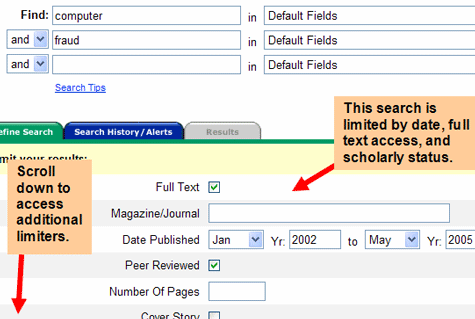
- Limiting Your Results
In Ebsco, you can limit your search results by date, format, type, etc. Limiting by various fields will reduce your overall search results and make them more specific to your individual research needs.


- Truncation: Using Symbols to Expand your Search
Using a truncation symbol in your search terms tells the system to search for the word you enter along with any other words that have the same root. In Ebsco, the asterisk (*) is the recognized truncation symbol.


- Saving Searches: Marking Your Records
One useful feature in Ebsco is that you can save your search results. As you review your list of items, mark the articles that you think may be useful by clicking on the folder to the right of each citation.


- Saving Searches: Ebsco allows you to save records and view your search history. To save records, mark those that you need and download for printing, or save them to a disk, portable drive, or your student server space. You can also access your research summary by clicking on the "Search History/Alerts" tab at the top of your results list.

Thursday, August 9, 2012

Library no es libreria. Semejanzas y diferencias.


Hoy me sucedió algo gracioso. Trabajando y haciendo una búsqueda para la clase mañana se me acercaron varios padres para saber donde vendían los uniformes y los materiales escolares. Aquello me extrañó algo pero luego me di cuenta. La venta era en la libreria del colegio, no en la biblioteca.
Durante mucho tiempo expliqué a mis alumnos la diferencia entre ambas. Ellos al principio se mostraron reacios pero luego entendieron. Así que me doy cuenta ahora que el mal es mucho más profundo. Es necesario educar y enseñar a todos niveles de nuestra sociedad. La cultura es el medidor del nivel de un pueblo, de sus logros y sus conquistas. Cuando algo tan elemental es desconocido es que el problema es muy grave en el fondo.
Aqui le muestro algunas de las diferencias que existen entre ambas. Vayan anotando.
Librería:
Una librería es un establecimiento comercial o tienda que se dedica a la venta de libros. Existen librerías de todo tipo, desde pequeños locales con pocos ejemplares hasta edificios enteros que ofrecen miles de publicaciones. Las librerías pueden pertenecer a una cadena con muchas sucursales o tener un único punto de venta.

Por ejemplo: “Ya estuvo en cinco librerías pero sigo sin encontrar el nuevo libro de Michael Krepcky”, “Mi nieto trabaja en una librería del centro”, “Dos heridos en un intento de robo a una librería”.
Hay librerías generalistas que comercializan libros de diversas temáticas, mientras que otras se especializan en temas específicos. Es posible, en este sentido, encontrar librerías deportivas, librerías científicas, etc.

Las librerías también pueden vender libros usados. Estas tiendas, por lo general, se dedican a comprar ejemplares a un cierto precio para revenderlo luego a un precio mayor, ganando con la diferencia.

Las librerías virtuales, por su parte, se dedican a vender libros a través de Internet. Dichos libros pueden ser físicos (impresos) o digitales (para leer en la computadora o en dispositivos electrónicos).

En algunos países, se conoce como librería a la tienda que vende papeles, útiles escolares y diversos objetos de escritorio. En España, a estos establecimientos se los denomina papelerías: “Voy a la librería a comprar un cuaderno”.

Biblioteca: Se denomina biblioteca (término de origen griego) al lugar físico destinado al almacenamiento de una gran cantidad de libros, de diversas temáticas, destinado al uso público o privado. Dicho lugar es un espacio cultural, en donde se promueve el conocimiento y el estudio, como herramientas valiosas. Las bibliotecas suelen contener una gran cantidad de libros de distinta extensión, y referido a distintas edades (por ej.: libros infantiles), clasificados generalmente por temas (ej.: ciencias sociales, ciencias naturales, poesía, narrativa, etc.).

Las bibliotecas ya existían hace mucho tiempo atrás en la historia de la humanidad; las primeras bibliotecas fueron las de Grecia, donde se destacaron principalmente las halladas en Alejandría.

En las instituciones dedicadas a la educación, como las escuelas y universidades (tanto públicas como privadas), pueden encontrarse bibliotecas, disponibles especialmente para los alumnos, donde éstos pueden encontrar material bibliográfico útil para la realización de trabajos prácticos, y el estudio. No obstante, así como existen bibliotecas dentro de establecimientos, existen también bibliotecas que poseen un lugar físico determinado e independiente, dedicado exclusivamente al almacenamiento de material bibliográfico.

Además, gracias al avance de la tecnología, existen actualmente bibliotecas virtuales, accesibles desde Internet o presentes en una serie de CD-ROMs, que no requieren de espacio físico.

Las bibliotecas son un medio muy importante para la realización de trabajos de investigación, en los cuales se requiere una gran variedad de material bibliográfico; y para la ampliación del conocimiento y el progreso intelectual de toda sociedad.

Podemos además, encontrar otras dos acepciones a este término: se llama “biblioteca” al mueble utilizado para guardar y organizar los libros, que posee estantes; y a un conjunto considerable de libros. Este último significado es muy similar al nombrado en el principio del artículo; la diferencia radica en que no se considera al espacio físico en el cual se hallan los libros.

Tomado de:
http://sobreconceptos.com/biblioteca

Libraries and bookstores. What's the difference?


Today I received many visits in the library. Everybody was looking for the bookstore to purchase uniforms and books. Sometimes I had to explain to my students the differences between library and bookstore and they understand the reasons. But now I can see the problem. Even the older people, parents and other persons, don't know anything about it and call a place like a library a bookstore. Now I understand. We must teach everything about everything. Knowledge doesnt occupy place in our heads. 

So I decided to share this article:

One of the frequent comments that people, particularly young persons, make in and about public libraries concerns the age and appearance of what is present on the shelf. Most often these complaints are about material appearing to be old and, well, not always new and current like what is available in a bookstore. It is important to understand that there are differences in the purposes and functions of a public library and a bookstore, although there is a growing blurring of distinctions between the two institutions. Both places are vastly different from the past, where they were once perceived as cold and impersonal, but now are seen as being friendly and inviting to visitors.

A library is responsible for serving the information needs of the community in which it is present, and this is a matter of serving an often diverse audience. The first thing that mosr people think about is the educational material used by children and adult students, and this is an important audience that is served. It is not the matter of school textbooks being carried, but the supplemental and additional resources as well. These include the various encyclopedias, dictionaries, atlases and maps, directories, handbooks, and almanacs, as well as the works covering history, literature, drama, art and science. Frequently these are classic works that contain valid information, but are often out of print.


A bookstore is a for-profit business that is concerned with selling books and magazines, as well as various forms of media including music, DVD, and recordings of the spoken word. The inventory carried in such a business is often determined by consumer interest, and the likelihood of items being purchased. Similar to a library, there are various ways of determining what to make available to customers. Factors for analysis include records of past sales, customer feedback, and staying aware of forthcoming material and developing trends. While there is overlap between the audiences and customers served in a library and a bookstore, a bookstore usually serves a somewhat narrower audience.

The main difference between a library and a bookstore is that material belonging to the library is normally available for borrowing, free of charge, for a set period of time, after which it is to be returned. In a bookstore, the items selected are purchased outrightly from the store, and become the personal property of the customer. The goal of both places is to get people to read, and to keep them reading.

Friday, August 3, 2012

Jesse Owens Biography and Quotes - Biography.com

By Leila Taha


Jesse Owens, a record-breaking Olympic sprinter and the best athlete of his time, spent much of his life struggling with issues of race. Unlike other athletes of his era, Owens' day-to-day life was defined—and restricted—by his color. He suffered humiliating treatment even as he was revered as the most successful athlete of the day, winning four gold medals in the 1936 Olympics during Hitler's Germany. But the racism he experienced in a country on the brink of ethnic cleansing was hardly worse than what he faced back home in the United States.

For years after his athletic career winded down, Owens endured a personal struggle, leading him to prize wealth over principles as he criticized Civil Rights leaders of the late 60s. In the decade before his death, his philosophy on race relations progressed, and he finally advocated the Civil Rights Movement.

Jesse Owens was born James Clevelend Owens in Alabama in 1913, the youngest in a family of 10 children. When he was 9 years old, his parents relocated the family to Cleveland, Ohio, in search of better economic opportunity. It was there that Owens discovered his passion and talent for running. In junior high school, he met a coach whom he believed set him on the path to athletic success. Later in high school, he tied the world record for the 100-yard dash and the long jump, as well as set a new record for the 220-yard dash.

Owens attended Ohio State University, where his athletic success continued, but the racism and discrimination that was common in the 1930s became a detriment to his training and racing. Unlike his teammates, Owens was not allowed to live on campus because the university did not have housing for black students. Nor was he provided a scholarship, a privilege that would be standard for any white athlete of his caliber. When he traveled with the team to compete, he had to stay in separate hotels and eat in separate restaurants from the rest of the Ohio State track team.

Watch this clip of Jesse Owens:


Jesse Owens was a very successful college track star, but where he truly earned his fame was at the 1936 Summer Olympics in Berlin, Germany. The international sporting competition was rife with political controversy imposed largely by Adolf Hitler, then the German premier. Hitler’s staging of the games was largely intended to showcase white supremacy, and the very presence of a successful black athlete was a threat. And yet Owens’ Olympics performance was unlike any before it, or since. He won four gold medals and set new world records in the 200-meter race, long jump, 400-meter relay, and he tied the world record for the 100-meter dash. He had become the best athlete in the world.

His stay in Germany showed Owens that a different life was possible for him as a black man. Unlike back home in the United States, in Germany Owens trained, traveled and stayed in the same hotels as his white teammates. In the United States, Owens was asked to ride a hotel’s freight elevator to get to a reception being held in his honor.

Upon his return to the United States, Owens was faced with fresh challenges. He did not come home to the reception expected for such a winning Olympian. He was not invited to the White House and was personally insulted that he was not offered any honors by President Franklin D. Roosevelt. “After I came home from the 1936 Olympics with my four medals, it became increasingly apparent that everyone was going to slap me on the back, want to shake my hand, or have me up to their suite. But no one was going to offer me a job,” he later said.

Due to time spent training and competing at the Olympic level, Owens’ academics suffered, and he was declared ineligible to compete at the university level. He gave up on his education and began pursuing other career opportunities, from starting a Negro baseball league to opening a dry cleaning business. Three years after his Olympic success, he declared bankruptcy.


Despite his gold medals, Owens was still a student and had to pump gas during the summers to support his family. (Aug. 1, 1935)

Owens was censured for giving up on amateur athletics in pursuit of financial gain in other fields. But he argued that his hand was forced by the discriminatory policies he had faced throughout his athletic career, such as not being eligible for scholarships in college and therefore struggling to squeeze in classes between training and working to pay his way. In an interview in 1971, he addressed the criticism head on, saying, “ I had four gold medals, but you can't eat four gold medals. There was no television, no big advertising, no endorsements then. Not for a black man, anyway.”

His post-1936 experiences seemed to shape his philosophy about race relations in the United States. Owens believed that blacks should fight for power through economic, not political means. In 1968, when Tommie Smith and John Carlos famously gave a black power salute while receiving their medals in the Summer Games in Mexico City for the 200-meter race, Owens spoke against them.

“The black fist is a meaningless symbol. When you open it, you have nothing but fingers—weak, empty fingers. The only time the black fist has significance is when there's money inside. There's where the power lies,” Owens said at the time.

In his older age, his philosophy seemed to have developed in the opposite direction, and he spoke out in favor of the Civil Rights Movement and even criticized his own previous statements.

In 1980, Jesse Owens died of lung cancer. It is unthinkable in the modern era that any athlete, much less a runner, would be a smoker, but he was for the most of his life.

Tuesday, July 3, 2012

Un dia en la Historia. Biografia de Franz Kafka


Franz Kafka

(Praga, 1883 - Kierling, Austria, 1924) Escritor checo en lengua alemana. Nacido en el seno de una familia de comerciantes judíos, Franz Kafka se formó en un ambiente cultural alemán, y se doctoró en derecho. Pronto empezó a interesarse por la mística y la religión judías, que ejercieron sobre él una notable influencia y favorecieron su adhesión al sionismo.

Su proyecto de emigrar a Palestina se vio frustrado en 1917 al padecer los primeros síntomas de tuberculosis, que sería la causante de su muerte. A pesar de la enfermedad, de la hostilidad manifiesta de su familia hacia su vocación literaria, de sus cinco tentativas matrimoniales frustradas y de su empleo de burócrata en una compañía de seguros de Praga, Franz Kafka se dedicó intensamente a la literatura.

Su obra, que nos ha llegado en contra de su voluntad expresa, pues ordenó a su íntimo amigo y consejero literario Max Brod que, a su muerte, quemara todos sus manuscritos, constituye una de las cumbres de la literatura alemana y se cuenta entre las más influyentes e innovadoras del siglo XX.

En la línea de la Escuela de Praga, de la que es el miembro más destacado, la escritura de Kafka se caracteriza por una marcada vocación metafísica y una síntesis de absurdo, ironía y lucidez. Ese mundo de sueños, que describe paradójicamente con un realismo minucioso, ya se halla presente en su primera novela corta, Descripción de una lucha, que apareció parcialmente en la revista Hyperion, que dirigía Franz Blei.

En 1913, el editor Rowohlt accedió a publicar su primer libro, Meditaciones, que reunía extractos de su diario personal, pequeños fragmentos en prosa de una inquietud espiritual penetrante y un estilo profundamente innovador, a la vez lírico, dramático y melodioso. Sin embargo, el libro pasó desapercibido; los siguientes tampoco obtendrían ningún éxito, fuera de un círculo íntimo de amigos y admiradores incondicionales. 

El estallido de la Primera Guerra Mundial y el fracaso de un noviazgo en el que había depositado todas sus esperanzas señalaron el inicio de una etapa creativa prolífica. Entre 1913 y 1919 Franz Kafka escribió El proceso, La metamorfosis y La condena y publicó El chófer, que incorporaría más adelante a su novela América, En la colonia penitenciaria y el volumen de relatos Un médico rural. 

Tomado de: http://www.biografiasyvidas.com/
Títulos disponibles en nuestra biblioteca:

Franz Kafka's The trial: Presenta la versión ilustrada de la novela de Kafka "El Juicio", en la que un hombre se despierta acusado de un delito y es juzgado, condenado y ejecutado a pesar de sus intentos de luchar contra la burocracia. (Novela ilustrada para adultos en idioma Inglés)

Meditaciones: Entre otros muchos relatos maestros, este libro reúne varias obras que hasta ahora habian sido inéditas. En todas se presiente la tormenta y la angustia, el absurdo y la incongruencia de la vida diaria, señales imborrables del autor. Los relatos son:
La verdad sobre Sancho Panza -- El silencio de las sirenas -- Prometeo -- El reclutamiento de tropas -- Intercesor -- Gran ruido -- Primer mal -- El maestro de colegio de pueblo -- Preparativos de boda en el campo (I) -- Preparativos de boda en el campo (II) -- Consideraciones sobre el pecado, el sufrimiento, la esperanza y el camino verdadero -- Carta al padre


Thursday, June 28, 2012

500 visitas!!!!! Gracias a todos!!!!!

Al fin arribamos a las 500 visitas!!!!
Este blog fue creado como un sueño, como una manera de acercar más a los estudiantes a la biblioteca, una forma de atraer profesores a que sean parte de nuestro centro de información. Lejana está la epoca donde la biblioteca esperaba la vista de las personas. Ahora con tanta tecnología y dispositivos de información la gente deja de visitarnos y muchos, ignorantes al fin, predicen el fin nuestro. Nuestra principal misión es acercarnos a ustedes, no esperarlos sino atraerlos a nuestra biblioteca.
Estoy dispuesto a trabajar y seguir trabajando para que este lugar no sea olvidado. A pesar de los esfuerzos hechos para que la misma no funcione. Gracias a nuestros estudiantes y amigos seguidores aún sobrevivimos.
Esperemos que el nuevo año escolar sea mejor, que nuestra biblioteca siga recuperando el lugar que merece y que tengamos un poco más de lo que poseemos hoy, pero ya sin esperar por nadie, hagamos nosotros mismos de la biblioteca un lugar mejor.

GRACIAS A TODOS!!!!!!!!